Physical Address
304 North Cardinal St.
Dorchester Center, MA 02124
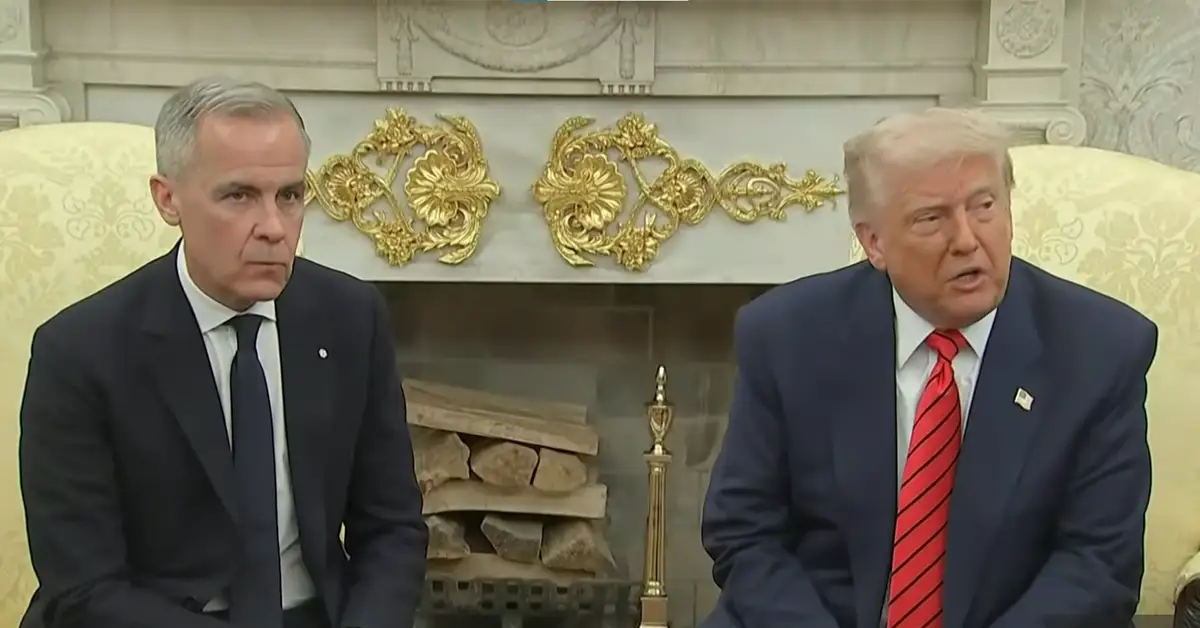
Canadian PM Mark Carney clashed with Donald Trump over tariffs and sovereignty in their first White House meeting, declaring “Canada is not for sale” against Trump’s annexation remarks. Though unresolved on trade, both leaders termed talks “constructive” ahead of G7 negotiations
Trade Tariffs Remain Unresolved as Leaders Agree to Future Talks Ahead of G7 Summit
Prime Minister Mark Carney’s first foreign trip since winning the election took him to a high-stakes White House meeting with President Donald Trump, where trade tensions, military cooperation, and Trump’s recurring annexation fantasies dominated discussions. While both leaders called the talks “constructive,” significant divisions remain on tariffs and trade. The meeting took a surreal turn as Trump mused about eliminating the Canada-U.S. border, prompting Carney’s sharp retort: “There are some places that are never for sale.” Canada Not for Sale.
Mark Carney walked into the Oval Office on Monday facing what may be the most consequential diplomatic challenge of his young premiership. managing Canada’s relationship with a mercurial U.S. president who has spent years attacking Canadian trade policies, mocking Canadian sovereignty, and now fresh off reimposing tariffs floating the idea of absorbing Canada into the United States.
This wasn’t just another bilateral meeting. For Carney, it was a test of whether his promise of a more “strategic” approach to U.S. relations could survive contact with Trump’s combative negotiating style. For Trump, it was another opportunity to frame Canada as a freeloading neighbor that owes the U.S. hundreds of billions a claim economists call absurd, but one that plays well with his base.
And for both men, it was a chance to size each other up. Carney, the former central banker known for his measured tone, versus Trump, the real estate mogul-turned-president who views diplomacy as a mix of brinkmanship and reality TV.
At times, the discussion struck surprisingly cooperative notes. Both leaders emphasized shared priorities like securing borders and cracking down on fentanyl trafficking. Trump even praised Canada for “stepping up” military spending a rare concession from a president who has repeatedly blasted NATO allies for not paying their “fair share.”
But the détente didn’t last. When talk turned to trade, Trump made it clear he has no intention of lifting tariffs on Canadian steel, aluminum, and autos anytime soon. “We have to protect American workers,” he insisted, ignoring the fact that Canadian industries have faced punishing costs since these measures were imposed.
Carney, for his part, didn’t back down. He reiterated Canada’s position that the tariffs violate trade agreements and harm both economies. “This isn’t just about Canada,” he told reporters afterward. “It’s about whether the rules we’ve all agreed to still matter.”
“A Beautiful Marriage”: Trump’s Annexation Obsession Returns
Then came the moment that overshadowed everything else.
As cameras rolled in the Oval Office, Trump seemingly out of nowhere revived his favorite geopolitical fantasy: the idea that Canada and the U.S. should merge. “When you get rid of that artificially drawn line… it’s a beautiful formation,” he mused, gesturing as if smoothing out an invisible map. “That’s the way it was meant to be.”
It wasn’t the first time Trump has floated this idea. During his first term, he reportedly asked aides about “acquiring” Greenland a request Denmark’s leader called “absurd.” But this time, he had a Canadian prime minister sitting right beside him, forced to respond in real time.
Carney’s reply was swift and firm: “As you know from real estate, there are some places that are never for sale.” The line drew laughter, but the message was unmistakable: Canada’s sovereignty isn’t up for negotiation.
Later, Carney revealed he’d asked Trump to stop referring to Canada as the “51st state” a label Trump has used for years, often while complaining about trade imbalances.
Trump, ever the showman, couldn’t resist a final tease. “Never say never,” he smirked. “Time will tell.”
The specter of trade negotiations loomed large over the meeting. Next year, the Canada-U.S.-Mexico Agreement (CUSMA) is set for its mandatory six-year review a process that could reopen old wounds.
Trump hinted that CUSMA might just be a “transitional step” toward a deeper U.S.-Canada deal, though he offered no specifics. Carney cautiously agreed that updates might be needed but stressed that any changes must respect the pact’s core principles.
Then, in a classic Trump diversion, the president pivoted to airing grievances about Carney’s predecessor. “I won’t say this about Mark, but I didn’t like his predecessor,” Trump said, referring to Justin Trudeau. He saved special vitriol for former deputy PM Chrystia Freeland, who led Canada’s CUSMA negotiations: “She was terrible… tried to take advantage, and she didn’t get away with it.”
The outburst underscored a recurring pattern: Trump often uses meetings with new leaders to trash their predecessors, a tactic that puts his counterparts in the awkward position of either defending rivals or staying silent. Carney chose the latter, avoiding a direct response.
The $200 Billion Myth: Trump’s Favorite Talking Point
No Trump-Carney meeting would be complete without the president trotting out his most misleading claim: that the U.S. “subsidizes” Canada by $200 billion a year.
Economists have repeatedly debunked this. The figure appears to conflate trade deficits (which are normal between nations) with fictional “subsidies,” and it ignores the fact that Canada is the top export market for most U.S. states. But Trump brought it up anyway twice first in a pre-meeting Truth Social post, then again during their discussion.
Carney didn’t challenge him publicly, but afterward, he emphasized Canada’s plans to boost defense spending and diversify trade partnerships, a clear signal that relying less on the U.S. is now a strategic priority.
The two leaders agreed to keep talking, with the G7 Summit in Alberta next month offering another opportunity for progress. But the path forward is murky.
Trump’s tariffs remain a major obstacle, and his annexation comments though likely unserious risk inflaming Canadian public opinion. Meanwhile, Carney must balance standing firm on sovereignty with avoiding a full-blown trade war.
One thing’s certain: This won’t be the last time these two spar. As Carney put it, “We’re engaged now very fully engaged.” Translation: Buckle up.